| |
|
|
|
back to Simple Cars main |
 |
About designing the Simple Cars
|
 |
|
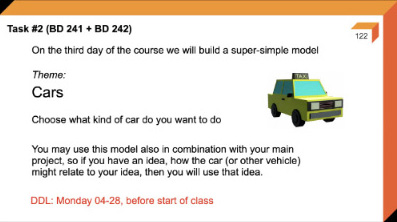
Original announcement of the Simple Cars homework from my presentation file.
|
| |
|
The Simple Cars project was started as part of my 3D-design course, which teaches the basics of Blender in combination with applying them in graphic design.
Looking for a simple and fun model subject, I thought of cars, as they can be done with a simple boxy design and include also round elements (the wheels).
Originally I planned to do a very simple basic car only, but then I thought it may motivate students more to have more different cars to choose from.
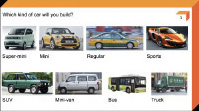
So I selected 8 types of cars to choose from.
|
| |
 |
|
 |
|
|
|
| Introduction of the 8 categories of cars. |
|
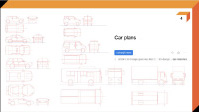
Three views for the 8 categories of cars. |
| |
|
|
|
|
In order to achieve a similar style, correct sizes and most of all give an easy reference that already shows the correct shape, I created 3-views for the 8 cars.
These were drawn in a way that the parts align and that it can be seen easily, where one part needs to be, also to let angles align to make it easier.
Determining the correct parts would be a lot more difficult when working from round 3-views.
The 3-views were provided to the students as Blender files. I also created videos for each car category which show how to build them. If you want to design a car yourself, you may find these documents and videos here.
|
 |
|
 |
|
|
|
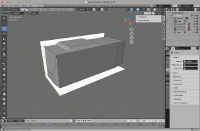
| Basic shape of the bus. |
|
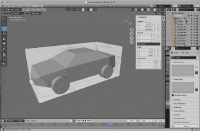
The basic car. The cylinders at the sides are not the wheels but the part to be cut out as fenders. |
| |
|
|
|
| |
| Students then had to work on the models, which I of course had all built in Blender one time. I had also built a bus, basic car and van in 1:30 to inspire the students.
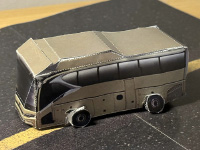
The cars except the truck all have a very similar structure, with slight modifications. The Bus is actually the most simple one, basically a box, with trapezoid extensions to the top and front. Then the fenders will be cut out
with a cylinder or rounded box, with the wheels as cylinders. Rear-view mirrors differ on the cars, but are usually based on a distorted box as well.
Because of its simplicity and because I had mentioned it is the simplest, the Bus turned out the most popular. But I did give away my finished model file which many students took as an invitation to just modify my artwork
instead of creating their own. Others were very creative with their own artwork. Some students even created all new models not conforming to any of the examples given, which was nice to see.
|
| |
 |
|
 |
|
|
|
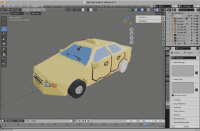
| Basic car with a demonstration of texture paint. |
|
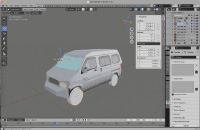
On this van I showed how to add photo patterns in Blender. |
| |
|
|
|
To paint the model, there were a number of options: First, to draw the model using the texture paint function, which is fun, but can be hard to control.
Second, pasting pre-prepared artwork or photos on the model in Blender. Third, to export out and create the artwork in Adobe Illustrator, which I recommended
because the students are the most familiar with that, fourth and fifth to paint the model by hand, either after printing or after building. I was happy to
see quite a few students making use of this most creative and artistic option. Some really fun ones came out with this.
As absolute beginners in papercraft, students mostly had problems with the rear-view mirrors, the wheels and those who did the Mini Cooper with the hood.
|
| |
|
| |
As for the versions of the models you can download, four of them were created by me during the course: The basic car as Ningbo taxi, the Ningbo Public transportation bus, the China Post truck and the red sports car.
After the end of the term, I took time to create additional versions and do the other four. The funny thing about the artwork is actually that the surface that took the most time on each model is the one hardly seen: The bottom.
Interesting are the Stahlhart Bus, which I created as a bus with ad on it and marketing slogans in Chinese (“The worlds top free papermodel brand”) and the racing sports car, which has a number
of “sponsors” related to me (the glue and software I use, my university, my bank).
What turned out to be a bit troublesome was the scale. While I had roughly estimated the size of all cars based on the mini EV, it turned out that the scales in comparison seemed not so correct, when I built the models.
So I had to go back and re-scale some of them, especially the Mini Cooper, but also the van and SUV. As the final scale I chose 1:32, which makes them easy enough to build for beginners while also being a popular scale
for car models.
With other things taking precedent, publishing was delayed again and again until after the winter term I finally had time to release them. Now they are yours also.
You can build them, build the white versions and paint them yourself or even design them from the start up tutored by the videos.
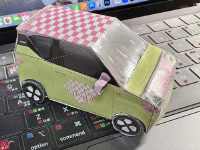
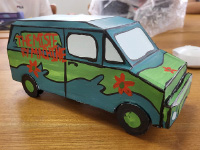
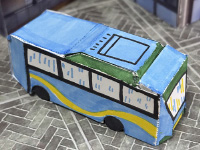
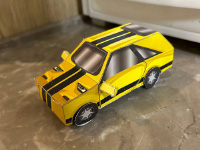
Here are 6 examples of cars done by students
|
| |
 |
|
 |
|
|
|
| mini EV by Coco |
|
Van by Margarita |
| |
|
|
 |
|
 |
|
|
|
| Bus by Cici |
|
SUV by Aruuke |
| |
|
|
|
| If you are interested to see more student models, you can watch the video about the simple cars, which includes 31 of the over 90.
|
| |
| return to top |
| |
|
|
|