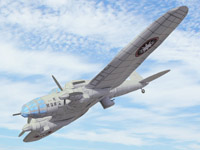
The He-111 model has earned a special place
in the history of Stahlhart papercraft. It has been in and out of development for almost
17 years. It was re-modeled and re-done numerous times and with 75 versions it will probably
remain the model with most versions for a long time if not forever. It almost got lost
during development and the work moved with its designer from flat to flat. When it came out, it was already legendary. It is also the end of an era, as it is the last
Stahlhart model to be produced entirely without the help of 3D-software. Some of the
details of the development are hard to remember after such a long time and many images of
the development have been lost, but I will still try to tell the story of this model.
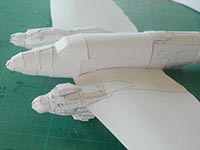
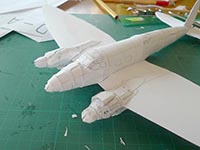
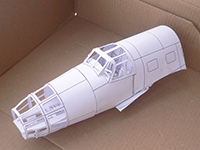
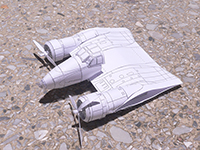
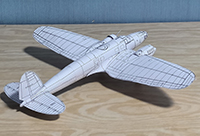
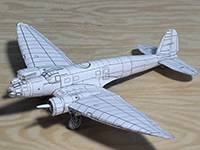
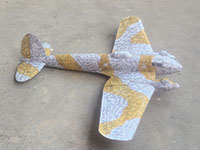
The only surviving photos of the prototype. From side still without panel lines.
General view of the full prototype
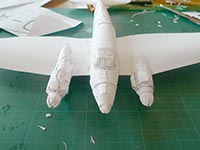
From the front.
Side view with all panbel lines.
In fact, when I started Stahlhart papercraft,
the He-111 was one of the first models I had in mind. Because it had what I thought is
basically an oval cross-section and was therefore easy to do and it had the possibility
to do different versions including the Zwilling with its two fuselages.
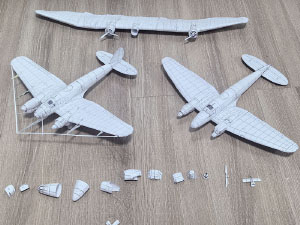
I created the prototype in 2009, when I was living in Beijing, China. The original
version had wings where the leading edge was folded. The prototype was hand-built based
on the 3-view. Panel lines of the wings were added in the 2D-software, then Macromedia Freehand. The model was taken apart and flattened to be scanned and then drawn on the computer.
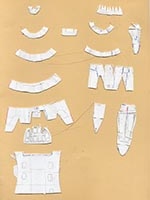
Flattened prototype parts: P/H-nose.
Airliner nose.
rear fuselage and tail.
Photos of the first two betas, which I did while
in Beijing were lost, but based on the still existing files, I can retrace that they were done
in 2011 and 2012 respectively. In the early versions the fusleage was too slim and was enlarged
several times, also the fuselage end was too thin, which can still be seen in the beta 3, this
was later rectified.
The Beta 3, with early fuselage.
Note how the cockpit area windows are different from the final version.
The development went into hibernation
as I was working on different other models. I started to continue after the release
of the Cessna Tweet in 2019, that is after I moved my home 4 times, back to Germany
from China and 3 times in Germany. During that time I did the Beta 3, which was the
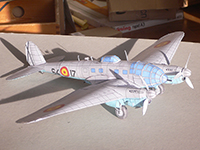
first version that appeared as a “work in progress” image, as the Casa 2.111.
It looked almost finished, but massive changes were to come. Shortly after I did this beta,
I moved back to China.
Beta 4, build with two A-engines for the preview image.
The other Beta 4, with cable cutter, pylons and two different engines.
All parts of the Beta 4 build, including the first version of cockpits.
Shortly after my return to China,
the CoViD-time began and not being able to work and just sitting in a flat in Huaibei,
Anhui Province, I had time to work on my models. During that time I made parallel development.
This was because no printshop in this city of 2 million people had the correct 120 gsm paper
to print on and I had to let many pages be printed in a remote copyshop and sent by mail,
o I had various models in production printed together and made changes on them one by one.
.
A-type Beta 4 as preview image.
Beta 5 from below, note how the fuselage has been widened with a cut at the bottom.
Another cut in the nose on the top here. Note how the rear fuselage angles down slightly.
Beta 5 as B-type preview image
During this time, the He-111 went through 3 Betas. You have to understand that one beta in
this case means several models, as three different noses, two different wings and during that
time 5 different engines had to be built. During this time I also did the two main cockpits, which went through 2 testbuilds each
First test build for the early cockpit.
First test build for the P/H cockpit.
Inside of the birdhouse nose with panels.
Cockpit testbuild within a 1/30 nose.
Cockpit testbuild within a 1/30 nose.
After CoviD, I moved to Zhuhai, China. There I continued parallel development and during 3 years I built two betas,
7 and 8. Most builds for this model had two different engines during that time of development.
During this time I understood that the engines of B-D-E-F and P-G types were not the same,
so the P-H engine was modified to now have 6 different engines: The A-type engine,
two versions of air-cooed radial engines, two similar yet different inline engines
for the principal types and the Merlin engines for the CASA 2.111. By compounding
the parts of two beta builds, I produced full versions of various types.
I had also tested the Zwilling-wing many times, but never built a full one.
During this phase of the development I had massive difficulties with the engines,
because in each test build they angled in a different direction which was very frustrating.
I finally identified the wing as the problem, because a different wing shape affected the
installation of the engines.
I first considered keeping the wing as is but adding formers but
then I looked at photos of the actual wing and decided the folded leading edge is not correct
and that the thick wing with round leading edge is a typical characteristic of the He-111.
So I completely redesigned the wings.
The Beta 6 of early bombers. Note the rear fuselage middle part has an open area where it was corrected.
Betas 5 of airliners. Just the nose with two variants of the air-cooled engines.
Beta 5 for P/H woth two different engines and V-1.
Bottom view of the same.
All Principal versions of Beta 9: E-type in the top, L-type on the left, C-type in the bottom and H-type on the right side.
During my time in Zhuhai, within short time,
my 10 year old MacBook and my archive harddrive crashed within short time.
For a moment it looked as if all development until that point had been lost,
but fortunately some South Chinese tech geniuses were able to bring back most
of the data from both, so I was able to continue. But it was then when I lost many
photos from the development. Other photos I was simply not able to find anymore when
preparing this.
The Beta 10 with all-new wings.
the same with landing gear, with A/C-type engine and A-mod engine.
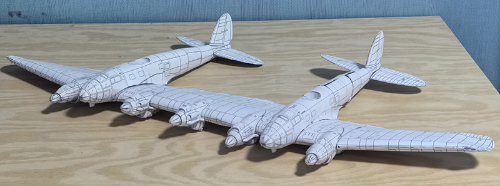
The first full Zwilling. Built from fuselages and engines of earlier testbuilds. Note how the outer engines are a different version of the engines.
I then moved from Zhuhai to Ningbo, China.
During that time I published the Long March 5 and then gave up parallel production to focus on
the He-111. I had to transition the software from Macromedia Freehand to Affinity Designer,
as Freehand no longer worked on a new MacBook. The betas with the new wing came out and I put
together a first full Zwilling during that time. I’m not sure during what time, but I
completely redesigned all three noses and the rear fuselage, ending up with two fuselage versions,
one which was more accurate compared to the 3-view, one more bulgy which I felt looked better
compared to photos and it was that version I chose in the end. The turret (B-stand) and windows
were moved around several times until I settled on the final positions.
Beta 11 of the airliners. Note the missing tail, different engines and open cockpit.
Beta 11 of the late variant, with different engines and cable cutter device. Cockpit also open.
All testbuilds from Beta 11, note different engines on the Zwilling-wing and small additional parts in front.
After Beta 11, the development of colour
betas started. This time I drew the lines directly in the software which worked great.
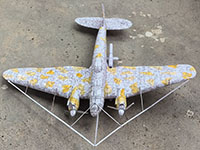
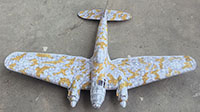
Each round of testbuilds had the P-H camos which inlcuded 8 different camos represented
by different coloured lines and the early bombers versions which basically had only the
splinter camo. During testbuilds I painted out the lines with paint to make sure no part
of each paint job was missing. This went through another 11 testbuild rounds, with the
betas 21 and 22 being only parts of the fuselage as all else was already done.
Effectively I could say I did over 40 testbuilds as each testbuild had two full
aircraft and additional parts. Final tests were done in October 2025 and the creation
of versions could begin.
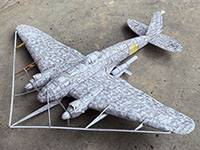
An early color beta, with V-1 and cable cutter device.
The same seen from below.
Camo painted yellow with paint to confirm it’s complete: Trop version.
This is the meander version painted on top of the trop.
Here the paint is the Day V-1 carrier version.
Camo-test for the Royal Air Force version.
The creation of the versions meant printing
and building the fuselage, noses and engines many times to make sure paint job details
aligned correctly. At the end I counted about 90 of those. The H-111P night bomber
version was a kind of afterthought, which I originally hadn’t planned.
I first tried to modify the Edelweiss to create the night Bomber, but then redrew all
the small spots. For the Hungarian version I managed to create the Camo by using lines
of the 8 existing camo-versions where they crossed seams. I had missed, that the Hungarian
camo is not the Luftwaffe Standard-Camo. The creation of the instructions was also
very difficult, because of its complexity and the necessity to keep apart all the versions
clearly. In those last days I also created the upgraded cockpit which was to be optional
for the CASA 2.111s. Another thing I did for the model were the crews, where I
modified my existing pilots to have them in different postures for the gunners.
After a lot of consideration I decided to make no separate instructions for those 7
different figures, as they are basically the same as the existing pilots and creating
the instructions for each would be soo much extra effort for a handful of people that
may ever build the crew and who for sure would need to have a high skill level,
so should be able to figure (pun intended) it out themselves. Originally
I announced that I would release the He-111 versions one by one as I create them,
but as other aspects, such as instructions weren’t ready, I ended up having all
75 versions before I could publish. In summer 2026 I moved yet another time to a new
flat in Ningbo.
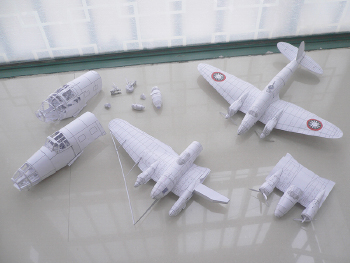
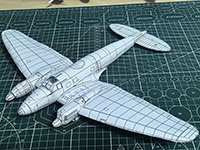
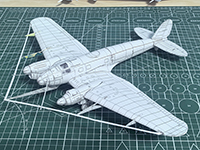
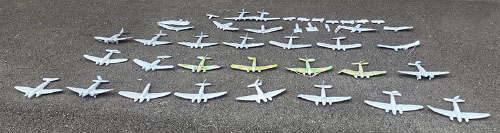
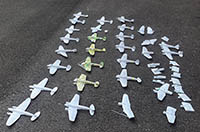
This is the largest amount of test builds to ever be photographed together. Starting with Beta 10 and all the way to 22
Another view of the same.
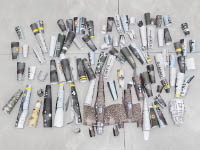
Collected livery tests for different versions.
The model was finally published in early October 2026.
Now it is up to modelers to create all those nice versions. I wouldn’t
want anyone to say that the model was “worth the wait’, because
the wait was just too long, but for me, it was like giving birth to a baby
that I had been pregnant with all those years. A real birth, and knowing how many
changes and improvements I have made and how many hours over hours I spend on this model,
I hope I can say about it the German phrase: “Was lange währt wird endlich gut.”
(What requires a lot of time will be good in the end.)
Check also the two development
updates I recorded if you haven’t seen them yet: